You’ve got the appointment booked, the passport in hand, and a growing pile of paperwork on your kitchen table that you’re not entirely sure is complete. That gap between “I think I have everything” and actually knowing is where visa applications go wrong. A missing bank statement or an accommodation proof that doesn’t cover every night of your trip can mean a refusal notice weeks later, not a quick fix at the counter.
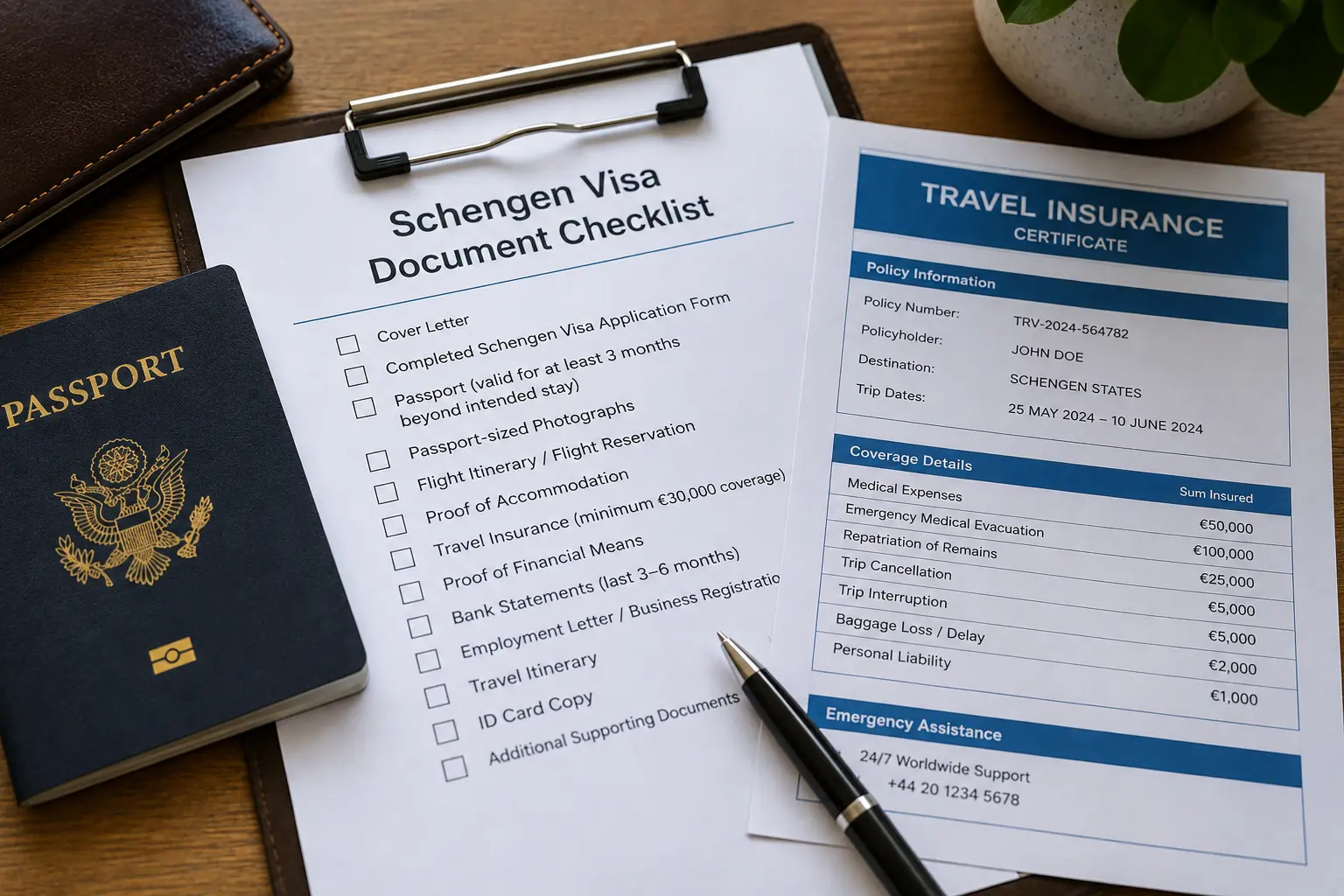
A solid visa document checklist turns that anxiety into a list you can physically check off. This article walks through what consulates actually ask for, where requirements differ between a Schengen Type C application and a US visitor visa, and how to build your own visa document checklist so nothing falls through the cracks before your appointment.
Why a Generic Checklist Isn’t Enough
Most visa document checklist you find online are written for no one in particular. They list “proof of funds” or “travel insurance” without saying how much coverage you need or how recent your bank statements have to be. Consulates are specific, and they reject applications over details that a vague checklist glosses over.
Take proof of accommodation. For a Schengen visa, that means a hotel booking, a confirmed Airbnb reservation, or a formal invitation letter from a host, covering every single night of your stay, not just the first few. If your itinerary has you in Paris for four nights and Amsterdam for three, the consulate expects paperwork for all seven nights, matching your travel dates exactly. A gap of even one night can trigger questions about where the consular officer thinks you might actually be staying.
The same logic applies to your travel itinerary. Round-trip flight reservations (not necessarily paid tickets, but reservations that show your intended dates) and a day-by-day plan help the officer see a coherent trip rather than a vague intention to visit Europe. If you don’t already have a structured itinerary, a travel itinerary generator built for visa applications can help you lay out your dates, cities, and accommodation in the format consulates expect to see.
The Core Documents on Every Visa Document Checklist
Regardless of which country you’re applying to, most consulates converge on a similar core set of documents. The exact combination and the order they want them in varies, but this is the backbone you’ll build from.
| Document | What it needs to show |
|---|---|
| Valid passport | Issued within the last 10 years, valid at least 3 months beyond your planned departure from the Schengen area, with at least two blank pages |
| Visa application form | Completed, signed, and consistent with every other document in your file |
| Passport-style photo | Recent, biometric-compliant, correct dimensions for the consulate you’re applying to |
| Proof of accommodation | Hotel bookings or host invitation covering every night of the trip |
| Travel itinerary | Flight reservations and a day-by-day plan matching your accommodation dates |
| Travel medical insurance | For Schengen applications, minimum €30,000 coverage valid across the whole Schengen area for the full trip |
| Proof of funds | Bank statements, typically covering the last three months, showing you can support yourself for the trip |
| Cover letter | Explains the purpose of your trip, your ties to home, and your travel plans in your own words |
Photos trip people up more than any other item on this list. Consulates specify exact dimensions and background requirements, and a photo booth print that looks fine to you can get flagged for the wrong head size or a shadow behind you. A passport and visa photo tool that checks your image against the required dimensions before you submit saves you a second trip to a photo studio.
The cover letter is the one document that’s entirely in your voice. It should explain who you are, why you’re traveling, what ties you back home (a job, a lease, family), and how the rest of your documents support that story. If you’re being invited by someone or need a formal letter for a business trip, a letterhead and cover letter generator gives you a professional-looking format that consulates recognize.
Schengen Type C: What Changes for a Short Trip to Europe
If you’re a US or UK passport holder planning a short tourist trip to Europe, you likely don’t need a visa at all for stays up to 90 days within any 180-day period — that’s the Schengen 90/180 rule, and it counts your days across the whole Schengen area, not per country. Non-US citizens residing in the US, and green card holders, may still need a Schengen Type C visa, so check your own nationality’s requirement before assuming you’re visa-exempt.
Anyone who does need a visa for a short stay applies for a Schengen Type C visa, the short-stay visa capped at 90 days. A Type D visa is a different thing entirely — that’s the national long-stay visa issued by an individual country for stays over 90 days, such as study or work. Don’t confuse the two when you’re building your visa document checklist, because the required documents and where you apply differ.
Two systems have also changed how you enter Europe even if you don’t need a visa. The EU’s Entry/Exit System (EES) replaces manual passport stamping with biometric checks — fingerprints and a facial photo — at the borders of the participating European countries, and it’s been rolling out since October 2025. Expect it to add time to your first border crossing while the system captures your data. Separately, ETIAS is a travel authorisation, not a visa, required for visa-exempt travelers entering Europe. It costs €20 and is valid for three years or until your passport expires, whichever comes first. As of mid-2026 there are two dates in circulation for when ETIAS actually goes live: eu-LISA’s official page still lists it for later this year, while industry and news reporting now points to a further delay into 2027 given the difficulties EES has had at the border. Check eu-LISA’s official ETIAS page before you travel, since this timeline has slipped more than once already.
A US Visa Document Checklist Looks Different
If you’re heading the other direction — applying for a US visitor visa from Europe, or helping someone apply to visit you in the US — the paperwork follows a different structure. The core visitor visa is the B-1/B-2, covering business and tourism respectively, and most applicants combine both purposes on one visa.
The centerpiece of a US visa document checklist is Form DS-160, the online nonimmigrant visa application. You complete it electronically, upload a photo that meets the State Department’s photo requirements as part of the form, and print the confirmation page to bring to your interview. From there, according to the State Department’s visitor visa page, consular officers may ask for additional evidence to establish that you qualify, which commonly includes proof you can cover the costs of your trip and evidence of ties to your home country.
Almost every applicant needs an interview at the US embassy or consulate covering the country where they live, though some limited exceptions exist. Processing times and fees for US visas move independently of the Schengen system and change without much notice, so check the current appointment wait times and fee amount on your local embassy’s page rather than trusting a number you saw somewhere else.
If you’re a citizen of a Visa Waiver Program country visiting the US for up to 90 days, you likely need ESTA instead of a visa — that’s an authorisation, the American equivalent of ETIAS, not a visa itself. Confirm your eligibility on the official ESTA application site before you book anything, since Visa Waiver Program eligibility depends on your nationality and travel history.
Turning This Into Your Own Visa Document Checklist
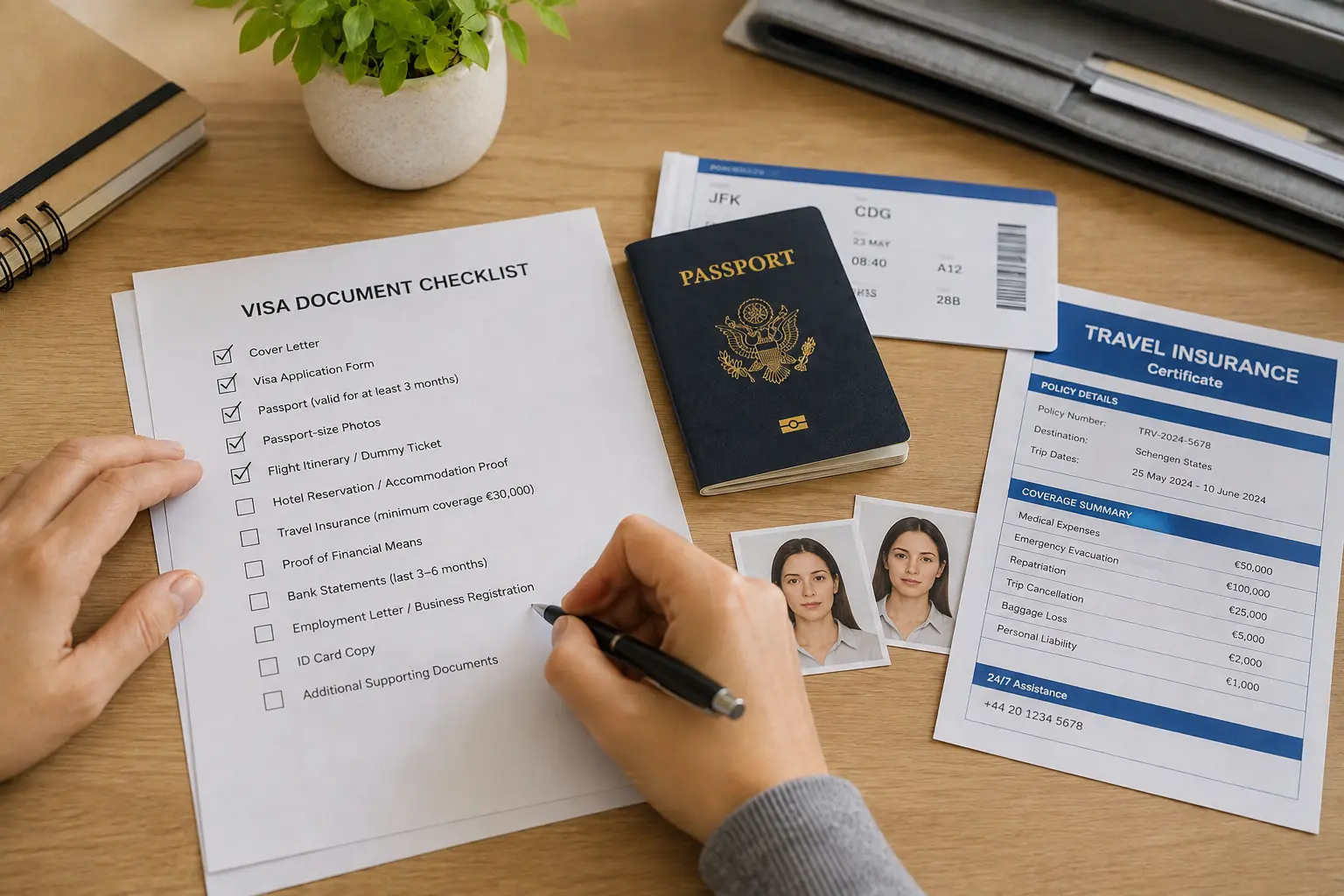
Reading a list is one thing; building your own visa document checklist against your actual trip is another. Here’s a sequence that works for most applications, whichever consulate you’re dealing with:
- Confirm which visa type applies to you and your nationality — don’t assume, because the rules differ by passport and by purpose of travel.
- Check your passport’s issue date and expiry against the destination’s validity rule before you do anything else.
- Lock in your travel dates and build a day-by-day itinerary that matches every accommodation booking you’ll submit.
- Gather financial documents — usually bank statements from the last three months — well before your appointment, since some banks take days to produce stamped statements.
- Draft your cover letter last, once the rest of your documents are finalized, so it accurately reflects what you’re submitting.
Every document you submit should reflect your actual travel plans. If your itinerary shows you spending five nights in Rome, your hotel confirmation should show the same five nights — not a placeholder booking you’ll cancel later. Consulates cross-check these details, and mismatches read as red flags even when they’re innocent scheduling slips.
That’s also true of accommodation proof more broadly. A confirmed reservation, even a fully refundable one, is what most consulates expect to see; it should represent where you genuinely intend to stay, not a document generated purely to satisfy a checklist item. If you haven’t locked in your hotels yet, a hotel booking proof generator can help you produce accommodation documentation once you’ve made real reservations, formatted the way consulates expect to review it.
Get Every Document Ready Before Your Appointment
Building a visa document checklist by hand, cross-referencing what one consulate wants against another, eats hours you’d rather spend on the parts of your trip you’re actually excited about. The core documents rarely change dramatically year to year, but the fine print — exact photo dimensions, insurance minimums, how many bank statement months you need — does shift, and it’s worth double-checking against your consulate’s current published requirements before you submit anything.
traveldocgenerator.com’s full set of visa preparation tools covers the pieces that trip people up most: itineraries, accommodation proof, passport photos, and cover letters, all built around the documents consulates actually ask for. Start with whichever document feels most overdue on your list, work through the rest at your own pace, and always verify the final requirements on your consulate’s official page before your appointment — a visa document checklist only helps if it matches what your specific consulate is asking for this year.
Ready to prepare your visa documents?
Generate itineraries, hotel booking proofs, passport photos and more in minutes - free.