You’re staring at the flight itinerary field on a visa application, and you don’t want to spend $600 on a ticket you might not even get to use. If your visa gets refused, that money is gone. But leave the field blank and the consulate might think you haven’t planned your trip at all.
This is exactly the problem a dummy flight ticket for visa applications is meant to solve. It’s not a fake document and it’s not a loophole — it’s a temporary, verifiable flight reservation that shows a consular officer your real travel plan without forcing you to buy a nonrefundable fare before you have permission to travel. Get the details wrong, though, and it can slow your application down instead of helping it. Here’s how it actually works, what consulates expect to see, and how to put one together honestly.
What Is a Dummy Flight Ticket for Visa Applications, and Do You Actually Need One?
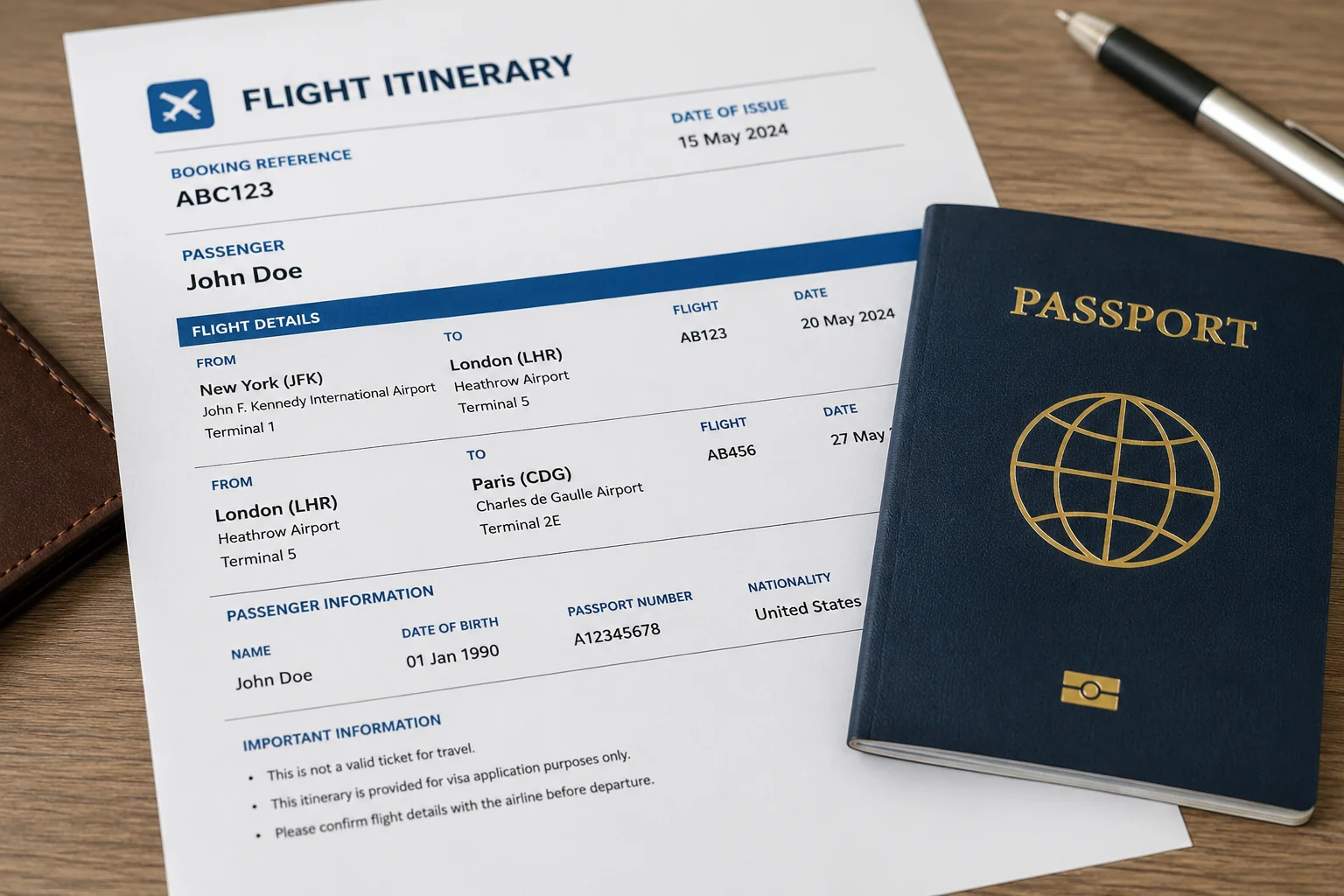
A dummy flight ticket for visa purposes is a flight reservation — usually with a real airline booking reference or PNR — that has not been paid for in full. Some airlines and travel agents will hold a reservation for a small fee or a short window at no cost, which is enough to generate a document that lists your name, dates, flight numbers, and route exactly as they’d appear on a paid ticket.
Consulates ask for this because they need evidence of your intended dates of entry and exit, not proof that you’ve already committed thousands of dollars to a trip you might not be allowed to take. A round-trip itinerary also helps demonstrate that you plan to leave the Schengen area, the UK, or the US before your permitted stay ends — which matters for a tourist visa review just as much as your bank statements do.
Not every applicant needs one. If you’re a US passport holder applying for a UK Standard Visitor visa online, or applying for the UK Electronic Travel Authorisation, the process is different from a Schengen Type C application submitted through a visa application center. Always check what your specific consulate or visa center asks for before assuming you need a reservation at all.
Why Consulates Discourage a Fully Paid Ticket Before Approval
This is the part a lot of first-time applicants get backwards. Buying a real, paid, nonrefundable ticket before your visa is approved is something consulates actively warn against, not something they require.
For US nonimmigrant visas, the State Department’s own guidance tells applicants not to finalize travel plans or purchase tickets until a visa has been issued — the DS-160 form even lets you enter “unknown” or tentative dates if you don’t have firm plans yet. The logic is straightforward: officers know that a visa refusal shouldn’t leave you out several hundred dollars for a flight you can no longer use.
The same caution applies broadly across Schengen consulates. A flight itinerary or reservation is normally accepted as evidence of your travel dates and intent to return, but a fully paid ticket isn’t the standard requirement — a verifiable reservation with your name, dates, and route is what officers are actually checking. Requirements do vary by country and by individual visa application center, so this is genuinely one of those details worth confirming directly with your consulate before you submit anything.
That’s the entire reason tools that generate a realistic, reservation-style itinerary exist. Not to fabricate a trip you’re not taking, but to document a trip you are planning, in the format a consulate expects, without the financial risk of a real booking. A travel itinerary generator for your visa application builds exactly this — a document that reflects your actual planned route and dates.
What Your Flight Itinerary Should Actually Include
Consulates and visa application centers are consistent on one point even when their exact requirements differ: the itinerary needs to be internally consistent with the rest of your application. Mismatched dates between your flight reservation and your hotel booking are one of the most common reasons an officer flags a file for extra review.
| Document element | What it needs to show |
|---|---|
| Full legal name | Exactly as it appears on your passport, no nicknames or shortened names |
| Booking reference or PNR | A code the airline or consulate can verify if they choose to |
| Outbound and return dates | Matching your stated length of stay on the application form |
| Realistic routing | Airports and connections that reflect a real, bookable journey |
| Consistency with other documents | Same dates as your proof of accommodation and travel insurance |
That last row matters more than people expect. If your flight shows you landing in Madrid on the 4th but your hotel confirmation starts on the 6th, an officer has to ask why — and a plausible answer costs you time you don’t have during a tight processing window. Generating your flight itinerary and your accommodation proof from the same trip details keeps everything aligned. A hotel booking proof generator that pulls from the same dates as your flight reservation is the simplest way to avoid that mismatch entirely.
How This Changes by Destination
Schengen Type C applications
If you’re applying for a Schengen Type C visa — the short-stay visa covering tourism, family visits, or business trips up to 90 days within any 180-day period — your passport also needs to have been issued within the last 10 years and stay valid for at least three months past your planned departure date from the Schengen area. This is separate from your itinerary but gets checked at the same appointment, so it’s worth confirming before you book anything.
US passport holders currently do not need a Schengen visa at all for short tourist stays; this itinerary guidance applies mainly to green card holders, non-US citizens residing in the US, and citizens of countries that do require a Schengen visa. If you’re a US citizen traveling to Europe, you’ll instead need to be aware of two systems that have changed recently. The EU’s Entry/Exit System (EES), a biometric check at the external borders of the participating European countries, has been fully operational since April 2026 — expect fingerprint and photo capture at your first entry rather than a passport stamp. ETIAS, the €20 travel authorization for visa-exempt travelers, is a separate requirement that is not a visa at all, and its launch date has slipped again: eu-LISA’s official page still lists late 2026, while several independent reports now point to sometime in 2027. Check the official ETIAS page directly before you travel, since this timeline has moved more than once.
US B-1/B-2 and UK Standard Visitor
For a US B-1/B-2 visa, the flight itinerary is helpful at your interview but isn’t a hard document requirement — the officer is more focused on your ties to home and your stated purpose of travel. For the UK Standard Visitor visa, or the UK ETA if you’re a visa-exempt traveler making a short visit, requirements are handled through the UK government’s own online systems, and specifics do shift, so confirm current guidance on the official visa pages before your appointment.
Building Your Dummy Flight Ticket for Visa Applications the Honest Way
Here’s the thing to keep in mind through all of this: a dummy flight ticket for visa purposes should reflect a trip you’re genuinely planning to take, on dates you actually intend to travel, to a destination you’re actually going. It’s a documentation format, not a workaround. Submitting an itinerary for a trip you have no intention of taking, or listing dates you know are fictional, is the kind of inconsistency that gets applications refused and can follow you into future applications too.
That’s also why it’s worth generating your itinerary and your supporting documents together rather than piecing them together from different sources. If you’re applying from Chicago for a Schengen visa and your accommodation is already booked in Lisbon, your flight dates, hotel dates, and travel insurance dates all need to tell the same story. Our travel itinerary generator for visa applications is built for exactly this — it creates a reservation-style document from the real trip details you enter, formatted the way consulates expect to see it, so you’re not stitching together a story from three different tools at 11pm before your appointment.
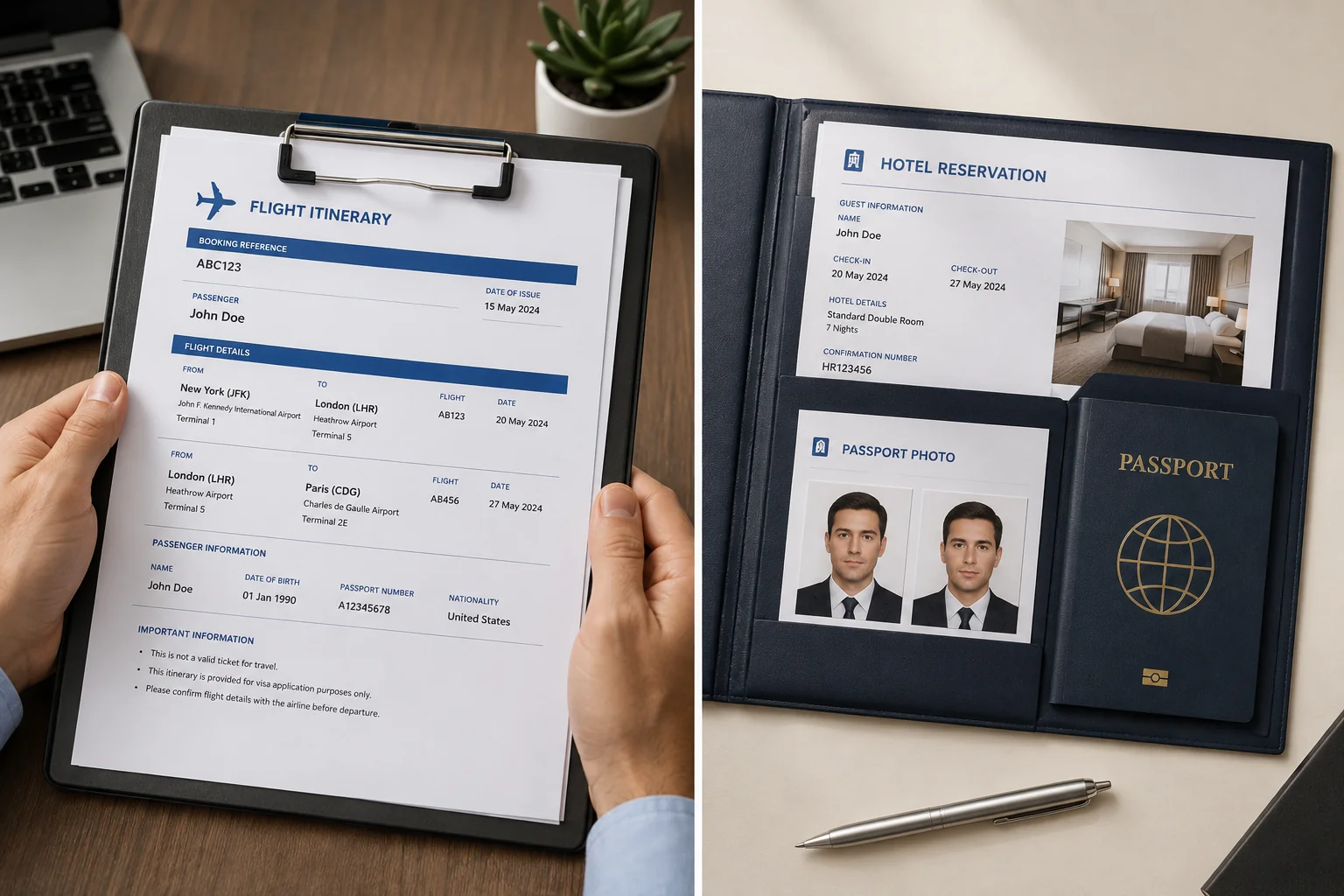
Whatever consulate you’re applying through, treat this article as a starting point rather than the final word. Visa document requirements shift by country, by consulate, and by your own nationality and residency status, so confirm the current list directly with your consulate or on your government’s official visa page before you submit anything. For US applicants, the State Department’s visitor visa page is the right place to check current guidance. If you’re pulling together a full application — flight itinerary, proof of accommodation, and a cover letter explaining your trip — it’s worth building them from one consistent set of trip details rather than four different sources, which is exactly what a dummy flight ticket for visa applications is meant to make easier.
Ready to prepare your visa documents?
Generate itineraries, hotel booking proofs, passport photos and more in minutes - free.