You’ve booked nothing yet, the appointment is three weeks out, and you’re staring at a consulate checklist that says “cover letter” and “proof of income” like you’re supposed to already know what those look like. You Google it and land on a page selling “fake visa samples” or dummy bank statements, and now you’re wondering if that’s actually how this works. It isn’t, and using one could sink an application you’d otherwise have won on its own merits.
This guide walks through what a real cover letter for Schengen visa applications needs to say, what a payslip or income document actually has to show, and why the templates that matter are the ones built from your real trip — not a sample designed to look convincing. We’ll also cover where fake or altered documents get caught, because consulates are better at spotting them than most applicants assume.
What a Schengen Visa Document Checklist Actually Looks Like
Every Schengen consulate — France, Germany, Italy, Spain, the Netherlands, and the rest of the 29 countries now applying the Schengen border rules — works from the same legal base, the EU Visa Code, but each embassy publishes its own document list and can ask for extra items depending on your situation. That’s why “just copy someone else’s checklist” is bad advice: a Type C application (the short-stay visa covering up to 90 days in any 180-day period) filed at the French consulate in New York won’t need exactly the same paperwork as one filed at the German consulate in Chicago, even though both are Type C.
That said, the core set of documents shows up almost everywhere. Here’s the pattern:
| Document | What it needs to show |
|---|---|
| Completed application form | Signed, matching your passport details exactly |
| Passport | Issued within the last 10 years, valid at least 3 months beyond your planned departure from the Schengen area |
| Cover letter | Purpose of trip, itinerary summary, funding source, and intent to return home |
| Proof of accommodation | Where you’re staying each night of the trip |
| Travel itinerary | Dates, cities, and how they connect logically |
| Travel medical insurance | Minimum coverage set by the Visa Code, valid across the whole Schengen area |
| Proof of income | Payslips, bank statements, or an employment letter showing you can fund the trip |
Two of those — the itinerary and the accommodation proof — are documents you build directly from your actual plans, not from a sample. A travel itinerary generator built for visa applications lets you lay out your real dates and cities in the format consulates expect, and a hotel booking proof generator does the same for accommodation, reflecting reservations you’re actually holding rather than inventing one from scratch.
How to Write a Cover Letter for Schengen Visa Applications
A cover letter isn’t listed as a mandatory document in the EU Visa Code, but in practice most Schengen consulates ask for one on their published checklist, and the officer reading your file uses it as the fastest way to understand your trip before checking the supporting paperwork. Think of a cover letter for Schengen visa applications as the one-page summary of everything else in your folder — it should never contradict your itinerary, bank statements, or flight booking.
A solid cover letter for Schengen visa applications runs one page and typically includes:
- Your full name as it appears on your passport, passport number, address, and the date
- Who it’s addressed to — the visa section at the specific consulate or visa center handling your application
- Purpose of travel: tourism, a conference, visiting family, or another stated reason, described specifically rather than vaguely
- A short day-by-day summary of where you’ll be and when
- How the trip is funded — your own savings, an employer, or a host
- Your ties to home: your job, lease, family, or enrollment that explain why you’re returning
- Your signature
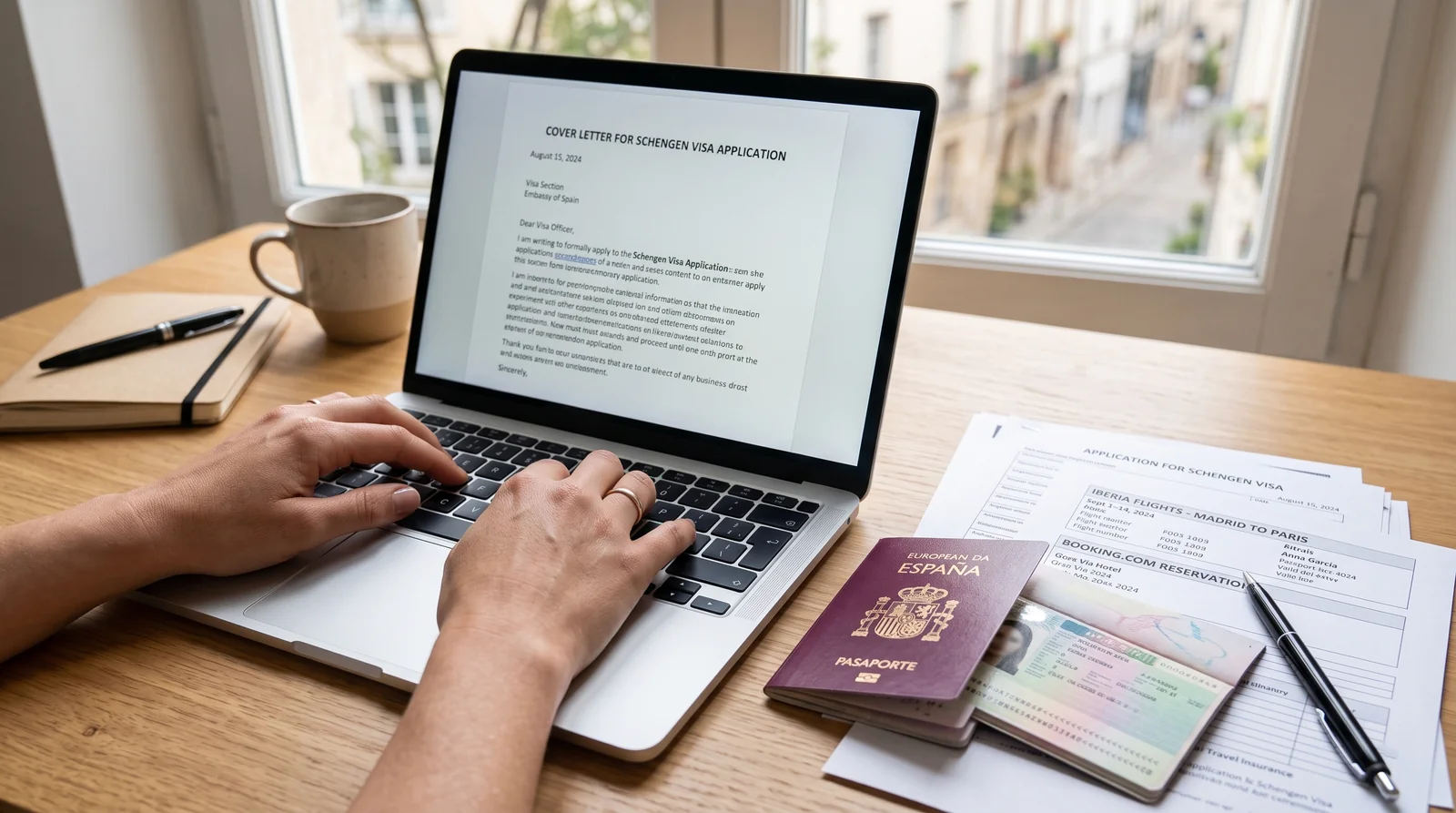
Where readers get into trouble is copying a “sample” letter wholesale and swapping in their own name. Consular officers read hundreds of these letters a week, and a template that doesn’t match your actual dates, doesn’t mention your specific city pair, or uses phrasing lifted from a visa blog is easy to flag. Write your own, in your own words, using a real letterhead format — a cover letter and invitation letter generator handles the formatting so you can focus on describing your actual trip accurately.
Payslips, Bank Statements, and Proof of Income Documents
Proof of income exists to answer one question: can you actually afford the trip you’re describing, without needing to work illegally or overstay to cover costs? Consulates typically want to see recent payslips — often covering the last few months of employment — alongside bank statements and, if you’re employed, a letter from your employer confirming your job, salary, and approved leave dates. Self-employed applicants usually substitute business bank statements and tax filings for payslips.
Exact windows differ by consulate and change from time to time, so don’t rely on a number you read on a forum. Check the specific document checklist published by the consulate or visa application center handling your case before you gather statements, and request any letters early — payroll and HR departments can take a week or more to issue an employment confirmation letter.
A few things matter more than most applicants realize. Your bank statement needs to show a stable balance, not a lump sum dropped in right before you applied — officers are trained to notice a sudden deposit that doesn’t match your regular income pattern. If a relative or sponsor is covering your trip, that usually needs its own sponsorship letter and the sponsor’s bank statements, not just a note added to your cover letter.
Why “Fake Visa Samples” Can Wreck Your Application
Searches for “fake visa samples,” dummy flight bookings, or padded bank statements are common, and it’s worth being direct about why they’re a bad idea rather than pretending the topic doesn’t exist. A cover letter for Schengen visa applications, or any supporting document, only works if it reflects your actual, intended trip. Submitting a document you know to be false — an itinerary for flights you never booked, a bank statement altered to show a higher balance, or a hotel reservation you canceled the same day you got the confirmation email — is documentation fraud, not a shortcut.
The consequences are worse than a simple refusal. Under the Visa Code, applications supported by fraudulent documents are refused outright, and the fraud can be logged in the shared Visa Information System used across the Schengen area, making future applications to any member state harder for years afterward. Consular staff are trained to check flight reservations against airline records, verify hotel bookings with the property, and spot inconsistencies between a cover letter and the rest of the file.
This is a two-sentence point worth repeating on its own: a document that reflects your real plans is not the same thing as a document designed to trick a reviewer. The former is what every legitimate travel document tool, including the ones on this site, is built to help you produce.
If your actual finances or itinerary are thin — you’re traveling on a tight budget, or you haven’t finalized every hotel yet — the better move is a cover letter that’s honest about that (a sponsor covering part of the trip, a booking you’re finalizing once the visa is approved) rather than a document that papers over it. Consulates see thin applications approved constantly when the story is consistent and truthful.
Building a Complete, Honest Document Set for Your Application
Since Europe’s Entry/Exit System (EES) became fully operational across all 29 participating Schengen countries on 10 April 2026, border checks now register biometric data — fingerprints and a facial photo — at entry and exit, and airports have seen longer queues through the summer of 2026 as the system beds in. It’s worth building in extra time at the border on your trip, especially at busy hubs. Check the official page from your destination country’s foreign ministry, such as France’s EES guidance, before you travel.
ETIAS, the separate €20 travel authorization for visa-exempt travelers (not a visa, and not required for anyone who already needs a Schengen visa), has slipped again. As of mid-2026, eu-LISA’s own materials still reference a Q4 2026 target, while industry and press reporting points to a further delay into 2027. Since this date has moved more than once, check eu-LISA’s official ETIAS page for the current status rather than relying on a date from an article, including this one.
None of this changes what you personally need to submit for a visa appointment — it just means double-checking the current rules before you travel, not just before you apply. Fees for Schengen visas are set centrally and reviewed periodically, so confirm the current amount on your consulate’s website before paying rather than budgeting from an old figure.
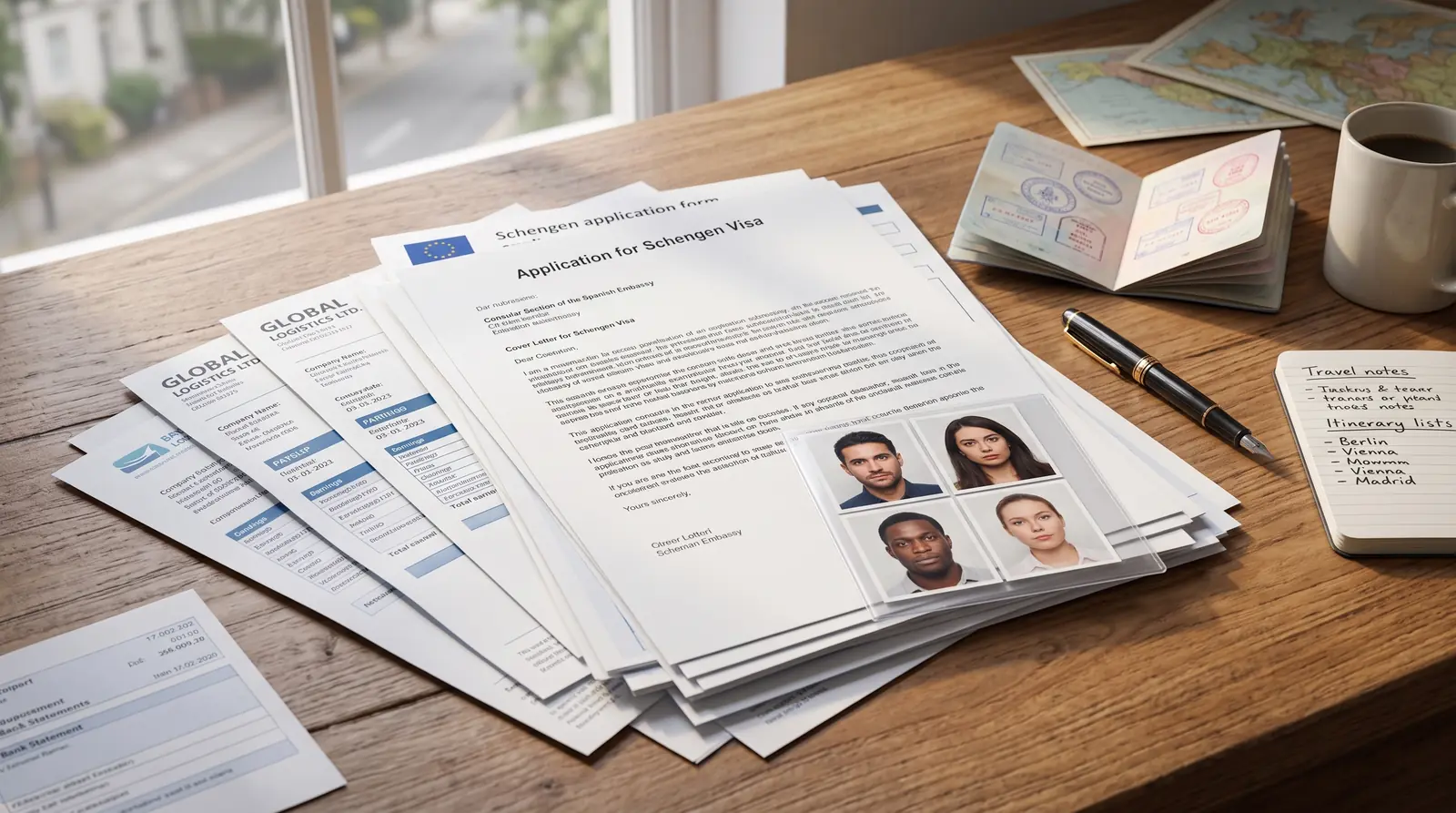
Pulling together a cover letter for Schengen visa applications, payslips, an itinerary, and accommodation proof is genuinely easier when you’re not starting from a blank page each time. Use a proper cover letter generator for the formatting, and check the full set of visa document tools for the itinerary, hotel proof, and photo generators that cover the rest of the checklist. Build every document from your real plans, verify the requirements on your consulate’s own site, and you’ll walk into your appointment with a file that holds together under a close read — which is exactly what gets visas approved.
Ready to prepare your visa documents?
Generate itineraries, hotel booking proofs, passport photos and more in minutes - free.