You’ve got a laptop, a remote paycheck, and a list of countries you’d rather be living in than the one you’re in now. What you don’t have is a clear answer to the question that actually matters: which country will let you stay, and what exactly will they ask you to prove?
That confusion is the whole problem with researching digital nomad visa requirements 2026 online. Every blog ranks a different “top 10,” half of them are written by relocation companies trying to sell you a package, and the actual numbers — income minimums, fees, processing times — change from year to year without much warning. This article walks through three of the most established programs (Portugal, Spain, and Estonia), what each one actually asks for, and how the documents you’ll need overlap no matter which country you pick.
What a Digital Nomad Visa Actually Is
Here’s the thing most articles skip: a digital nomad visa is not a tourist visa with a new name, and it’s not the same thing as an entry authorisation. In EU terms, these programs are almost always Schengen Type D national visas — long-stay visas issued by one specific country, meant for stays over 90 days, that eventually convert into a residence permit. That’s different from a Schengen Type C visa, which only covers short tourist stays of up to 90 days in any 180-day period, and different again from ETIAS, which isn’t a visa at all.
ETIAS is the pre-travel authorisation that visa-exempt travelers — including most US passport holders — will eventually need for short Schengen stays. As of mid-2026, eu-LISA’s official page no longer commits to the “last quarter of 2026” launch window it previously listed, and independent reporting now points to a 2027 start instead. None of that affects digital nomad visa applicants directly, since you’d be applying for a Type D visa through a consulate either way, but it matters if you’re weighing a short trial stay before committing to full relocation. Check eu-LISA’s official ETIAS page before you plan around any specific date.
Once you’re living in a Schengen country on a Type D visa, you’ll also cross paths with the EU’s Entry/Exit System (EES) — the biometric check now fully running across all 29 participating countries as of April 2026. It registers your entries and exits electronically, which is one more reason your paperwork needs to match your actual travel plans and dates exactly.
Portugal’s D8 Visa: Income, Fees, and Processing Time
Portugal’s D8 visa remains the most-discussed digital nomad route in Europe, and for good reason — it’s well established and the requirements are published. As of 2026, the income threshold sits at €3,680 a month for the main applicant, which is four times Portugal’s minimum wage, with a 50% increase required per spouse and 30% per dependent child. You’ll also need to show savings of roughly €11,040 in your account, backed by bank statements covering the last three months and, in many cases, the last twelve salary payments.
Documents Portugal asks for
Expect to gather: a passport valid at least six months beyond your intended stay, two recent passport-sized photos, proof of remote income (contracts or client agreements with companies outside Portugal), a criminal record certificate from your country of residence, proof of accommodation in Portugal, and international health insurance with a minimum of €30,000 coverage. The visa application fee at the consulate runs around €110, though translation, legalization, and insurance costs commonly push total out-of-pocket costs to €250–300 — confirm the current fee schedule with your consulate before you pay anything.
Processing time is where Portugal has gotten harder to predict. Official guidance still cites 30 to 60 days for consulate processing. In practice, backlogs at AIMA (Portugal’s immigration agency, formerly SEF) have pushed real-world timelines toward 6 to 9 months for many applicants as of mid-2026. Build that into your planning rather than booking a move-in date around the shorter figure.
Spain’s Digital Nomad Visa: How It Compares
Spain’s version works on similar logic but different numbers. The 2026 income minimum is roughly €2,849 a month for the main applicant — 200% of Spain’s minimum wage — with an additional €1,068 for the first family member and €356 for each additional dependent. No more than 20% of your income can come from Spanish clients, which matters if you do any local freelance work on the side.
Fees are split across stages. The consular fee is around €80, and if you later apply for the residence authorization through Spain’s UGE (Unidad de Grandes Empresas) office, that adds roughly €73 more, with renewal fees around €79. Officially, consular processing is meant to take about 10 business days. Realistically, apostille delays on criminal record checks and appointment shortages for the TIE residence card mean 2.5 to 4 months is a more honest estimate. Applying from a Spanish consulate abroad gets you a visa valid for one year; applying for the residence authorization from inside Spain can grant up to three years.
Estonia and the Rest of the 2026 Index
Estonia’s Digital Nomad Visa is smaller in volume but well documented. Income requirements range from roughly €3,504 to €4,500 a month depending on how the embassy calculates your average earnings, and you’ll need proof of remote work, valid health insurance, proof of accommodation, and a clean criminal record. The state fee for the Type D long-stay version is around €120; the short-stay Type C option runs closer to €90. Processing typically takes 15 to 30 days, and the visa itself is valid for up to 12 months.
Croatia, Greece, Malta, and a growing list of non-European countries also run digital nomad programs, and the pattern across all of them looks similar: proof of remote income from outside the host country, health insurance, a clean record, and proof of somewhere to live. Fees and thresholds shift often enough — several countries raised their income minimums for 2026 — that a comparison table is only a starting point. Always confirm current numbers on the issuing country’s own consulate or immigration site before applying.
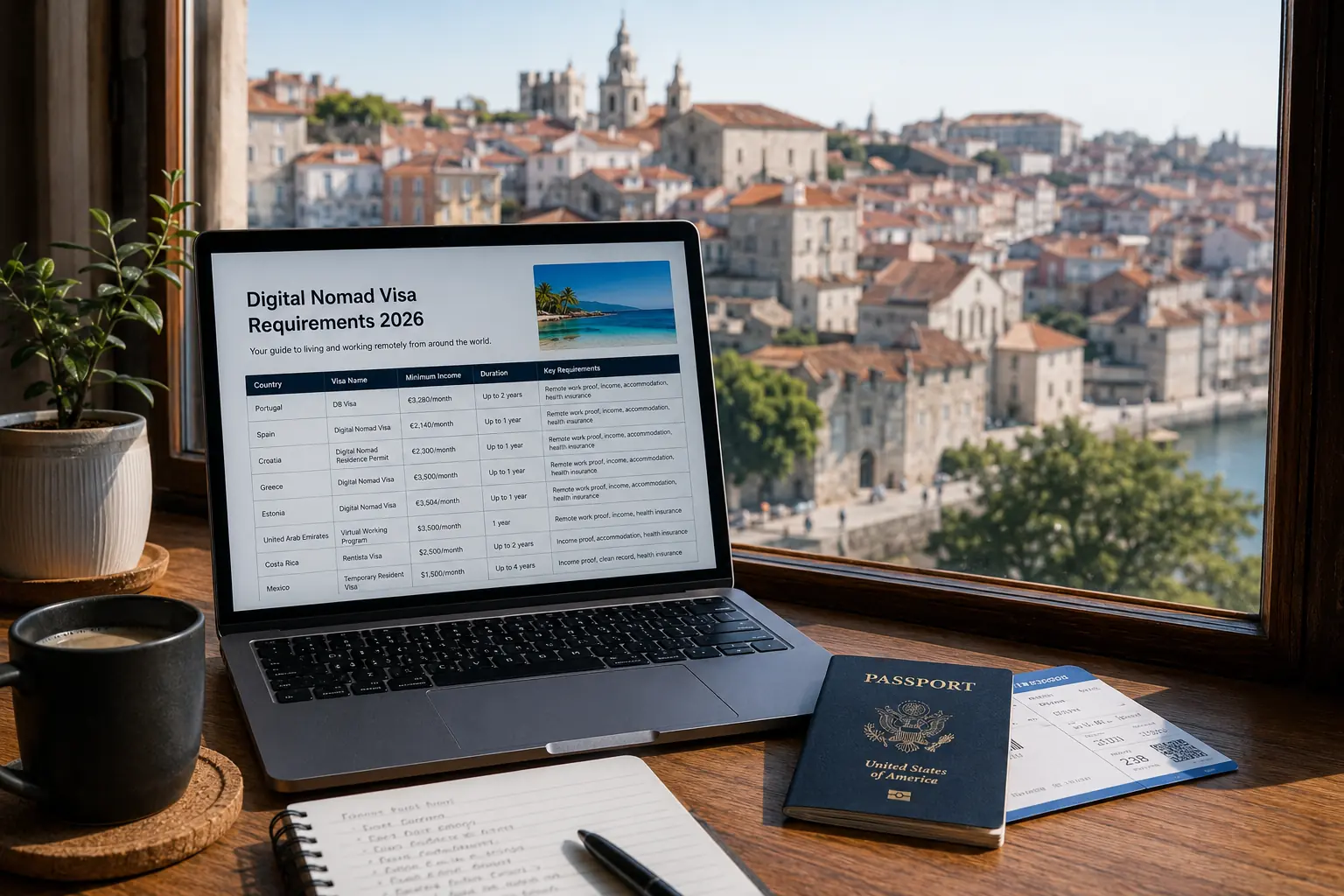
| Country | Monthly income minimum (2026) | Approx. visa fee | Typical validity |
|---|---|---|---|
| Portugal (D8) | €3,680 | ~€110 (consulate) + document costs | 1 year, renewable |
| Spain | ~€2,849 | ~€80 consular + ~€73 residence fee | 1 year (abroad) / up to 3 years (in-country) |
| Estonia | €3,504–€4,500 | ~€120 (Type D) / ~€90 (Type C) | Up to 12 months |
These figures move. Treat the table as a way to compare programs side by side, not as a number to quote in your own application.
Getting Your Documents Ready to Apply
Whichever country you choose, the paperwork overlaps more than the marketing pages let on. You’ll almost always need a passport photo that meets strict dimension and background rules, proof of accommodation that matches your stated arrival date, and — for programs like Portugal’s D8 — a cover letter explaining your remote work situation in plain terms for a consular officer who doesn’t know your job.
For the photo, most consulates specify exact dimensions and a plain background, and a photo taken on your phone rarely meets the spec on the first try. A tool built for this — like TravelDocGenerator’s passport and visa photo maker — checks sizing and background against consulate rules before you submit anything.
Proof of accommodation is where a lot of digital nomad applicants get stuck, especially if they haven’t signed a long-term lease yet. If you’ve booked a place to stay while you sort out permanent housing, TravelDocGenerator’s hotel booking proof generator creates a document reflecting that actual reservation — it’s meant to back up a real booking, not stand in for one you haven’t made.
A short cover letter explaining your remote income, your employer or clients, and why you’re applying can smooth over a case file that otherwise reads as thin. TravelDocGenerator’s letterhead and cover letter generator gives that letter a clean, professional format — useful whether you’re writing to a Portuguese consulate or a Spanish UGE office.
Start With the Documents You Can Control
Digital nomad visa requirements 2026 will keep shifting as more countries adjust income thresholds and tighten enforcement — that’s the nature of a policy area this new. What won’t change is that every one of these applications comes down to the same core evidence: who you are, how you’re paid, where you’ll live, and that you can support yourself without local employment. Get those four things right and you’ve done most of the hard part, regardless of which country’s threshold you’re chasing this year.
Before you submit anything, double-check the current income minimum, fee, and processing time on the issuing country’s own consulate or immigration website — none of these numbers are guaranteed to hold for the whole year. When you’re ready to start pulling your documents together, TravelDocGenerator’s full set of visa document tools covers the photos, accommodation proof, and letters most digital nomad applications ask for, all in one place.
Ready to prepare your visa documents?
Generate itineraries, hotel booking proofs, passport photos and more in minutes - free.