You’ve filled out the application form, gathered your bank statements, and booked travel insurance — and now the checklist says you need a confirmed hotel booking for Schengen visa purposes. So you open a booking site, see the total for two weeks in Europe, and your stomach drops. What if the visa gets refused? Do you really have to pay for a hotel you might never stay in?
You don’t. Consulates want to see where you’ll actually sleep every night of your trip, not proof that you’ve already handed over hundreds of euros to a hotel chain. There’s a right way to do this that satisfies the visa officer and protects your money, and a wrong way that either gets your application flagged or leaves you out of pocket if the visa doesn’t come through. This guide walks through exactly what a consulate expects, how to book without financial risk, and what else has changed at Europe’s borders that’s worth knowing before you travel.
Why Consulates Ask for a Confirmed Hotel Booking for Schengen Visa Applications
Every Schengen consulate — whether you’re applying through the French consulate in New York, the Italian visa center in London, or VFS Global on behalf of the German embassy — needs to see supporting documents relating to the purpose of your stay, including where you intend to live during your trip. That’s part of the standard document checklist the European Commission lays out for Schengen visa applicants. Proof of accommodation is one piece of a larger picture that also includes your travel itinerary, proof of sufficient funds, and travel medical insurance.
The confirmed hotel booking for Schengen visa applications doesn’t need to be prepaid in full, and it doesn’t need to be non-refundable. What it does need to do is show a consular officer, clearly and without ambiguity, that you have somewhere specific to stay for every single night between your entry and exit dates. Gaps in your accommodation timeline are one of the more common reasons applications get sent back for clarification, so your dates need to line up exactly with the travel itinerary you’re submitting alongside it.
If your trip involves multiple cities — say, four nights in Amsterdam followed by five in Berlin — you need proof of accommodation for both legs, not just the first. A travel itinerary generator for visa applications can help you keep the accommodation dates, city order, and travel dates consistent across every document you submit, which matters more than most applicants realize.
Free Cancellation Bookings: The Safest Way to Show Proof of Accommodation
Here’s the part that actually saves you money. Most major booking platforms let you reserve a room with free cancellation up to a set date before check-in, often with no payment taken at all until you arrive. That reservation still generates a full confirmation with your name, the hotel’s details, and your stay dates — everything a consulate needs to see.
Book this way and you’re covered either direction. If your visa is approved, you can keep the reservation, adjust it, or rebook something else entirely once your travel plans firm up. If it’s refused, you cancel before the deadline and you’re not out a cent. Airbnb and similar platforms are generally accepted too, but many charge at the time of booking rather than offering free cancellation, which makes them riskier to use purely for the application. If you do go that route, check the host’s cancellation policy carefully before you commit.
What you should never do is submit a hotel confirmation for a booking you have no intention of honoring, or invent a reservation that doesn’t exist. Consulates cross-check accommodation details, and a fabricated booking can lead to an outright refusal — sometimes with consequences for future applications too. The free-cancellation approach isn’t a workaround or a loophole. It’s simply booking real accommodation on flexible terms, which is exactly what any traveler planning a trip with an uncertain outcome would reasonably do.
A hotel booking proof generator can help you turn a real reservation into a clean, consulate-ready confirmation document that includes every detail an officer expects to see, formatted the way visa sections are used to reviewing them.
What Your Hotel Confirmation Must Include
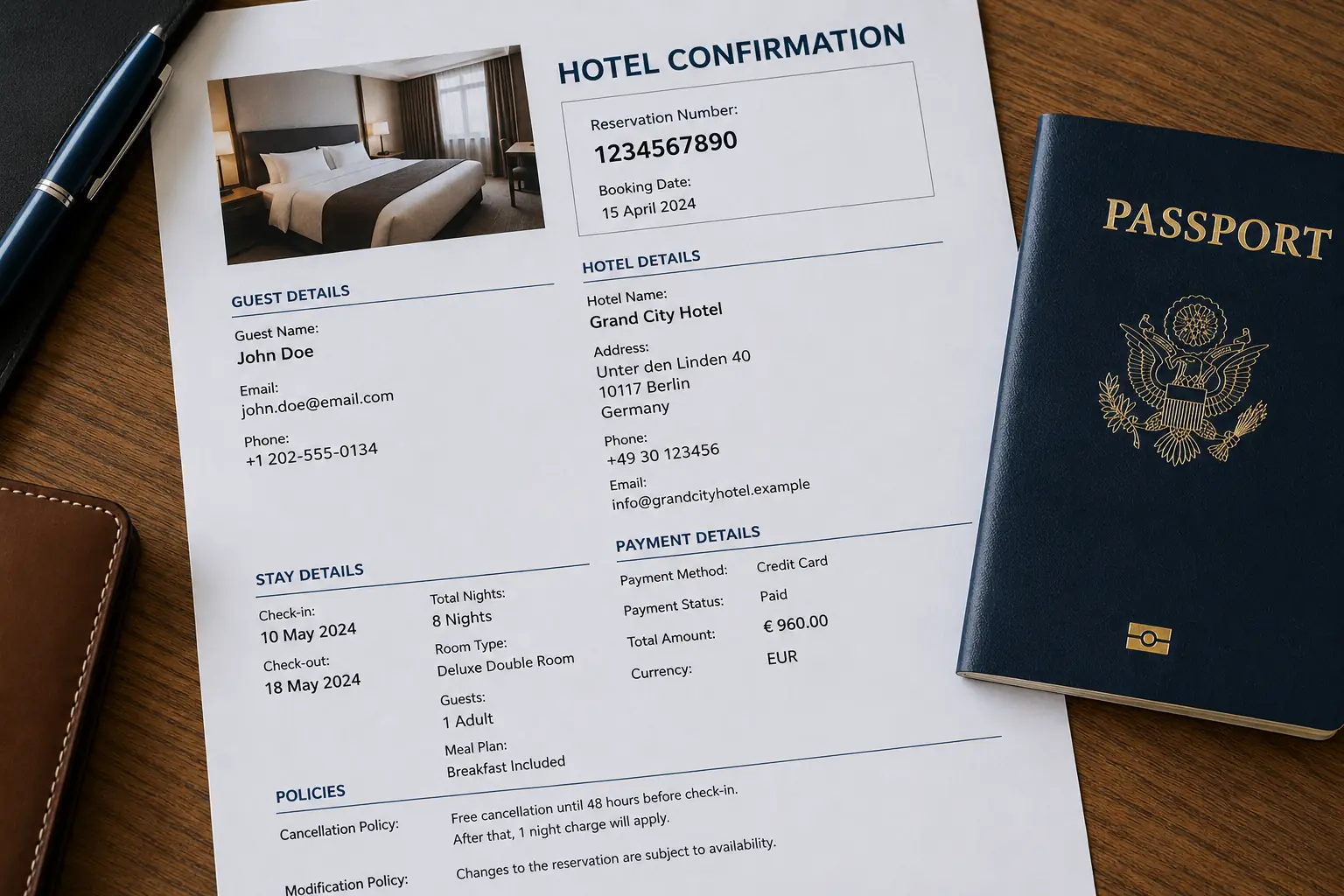
Not every printout works. A confirmation that’s missing a key detail can prompt an extra request from the consulate, which slows your whole application down. Before you submit anything, check it against this list.
| Detail | Why it matters |
|---|---|
| Your full legal name, matching your passport | Confirms the reservation belongs to you, not a travel agent or third party |
| Hotel name and full street address | Lets the consulate verify the property is real and located where you claim |
| A phone number or direct contact for the property | Allows verification if the officer wants to confirm the booking |
| Check-in and check-out dates | Must match the dates on your travel itinerary with no gaps |
| A booking or confirmation reference number | Ties the document to an actual reservation, not a screenshot mock-up |
| Cancellation policy, if applicable | Shows you booked responsibly and aren’t locked into a non-refundable rate |
If you’re staying with friends or family instead of a hotel, the document changes — you’ll typically need an invitation or host letter rather than a booking confirmation, sometimes accompanied by the host’s ID and proof of their own residence. Requirements for host letters vary by consulate, so check with the specific embassy or consulate handling your application before you rely on this route.
EES, ETIAS, and Other Entry Rules to Know Before You Book
Accommodation proof is just one part of a bigger picture that’s shifted recently at Europe’s borders. The EU’s Entry/Exit System, or EES, replaces manual passport stamping with a digital record of entries and exits for non-EU nationals on short stays, including facial images and fingerprints captured at the border. It began rolling out on 12 October 2025 and has been fully operational across all 29 participating countries since 10 April 2026 — so if you’re planning a Schengen trip now, expect to register biometrics the first time you cross a participating border, and build in extra time at passport control while the system beds in.
ETIAS is a separate matter, and it’s important not to confuse the two. ETIAS is a travel authorization for visa-exempt travelers — US passport holders heading to Europe for short tourist stays, for example — not a visa, and not something Schengen visa applicants need to worry about. It costs €20 and is valid for three years or until your passport expires, whichever comes first. As of mid-2026, its launch date is genuinely unsettled: eu-LISA’s official page still references a fourth-quarter 2026 start, while independent reporting from outlets like Forbes now points to a further slip into 2027 as EES rollout issues absorb border-system resources. Don’t book travel around either date — check eu-LISA’s official ETIAS page for the current status closer to your travel dates, since this timeline has moved more than once already.
None of this changes what you need for a Schengen visa application itself. US passport holders generally don’t need a Schengen visa for short tourist stays under the current visa-exemption rules, though green card holders and non-US citizens residing in the US may still need one depending on their nationality — check with your specific consulate if you’re unsure which category applies to you. If you do need a visa, your passport must have been issued within the last ten years and stay valid for at least three months beyond your planned departure from the Schengen area. Fees are set centrally across the Schengen area and have shifted before, so confirm the current amount on your consulate’s site rather than relying on a number you saw somewhere else — visa center service charges are added on top of the embassy fee and vary by location.
Get Your Accommodation Proof Sorted the Easy Way
Putting together a confirmed hotel booking for Schengen visa applications shouldn’t be the part of the process that stresses you out the most. Book with a free-cancellation option, make sure every detail on the confirmation matches your itinerary exactly, and you’ve covered one of the more scrutinized documents in your file without risking a cent if things don’t go your way.
The rest of your application deserves the same care. Keep your accommodation dates, travel itinerary, and cover letter consistent with each other — consulates notice when they don’t line up, and inconsistency is a far more common cause of delay than any single missing document.
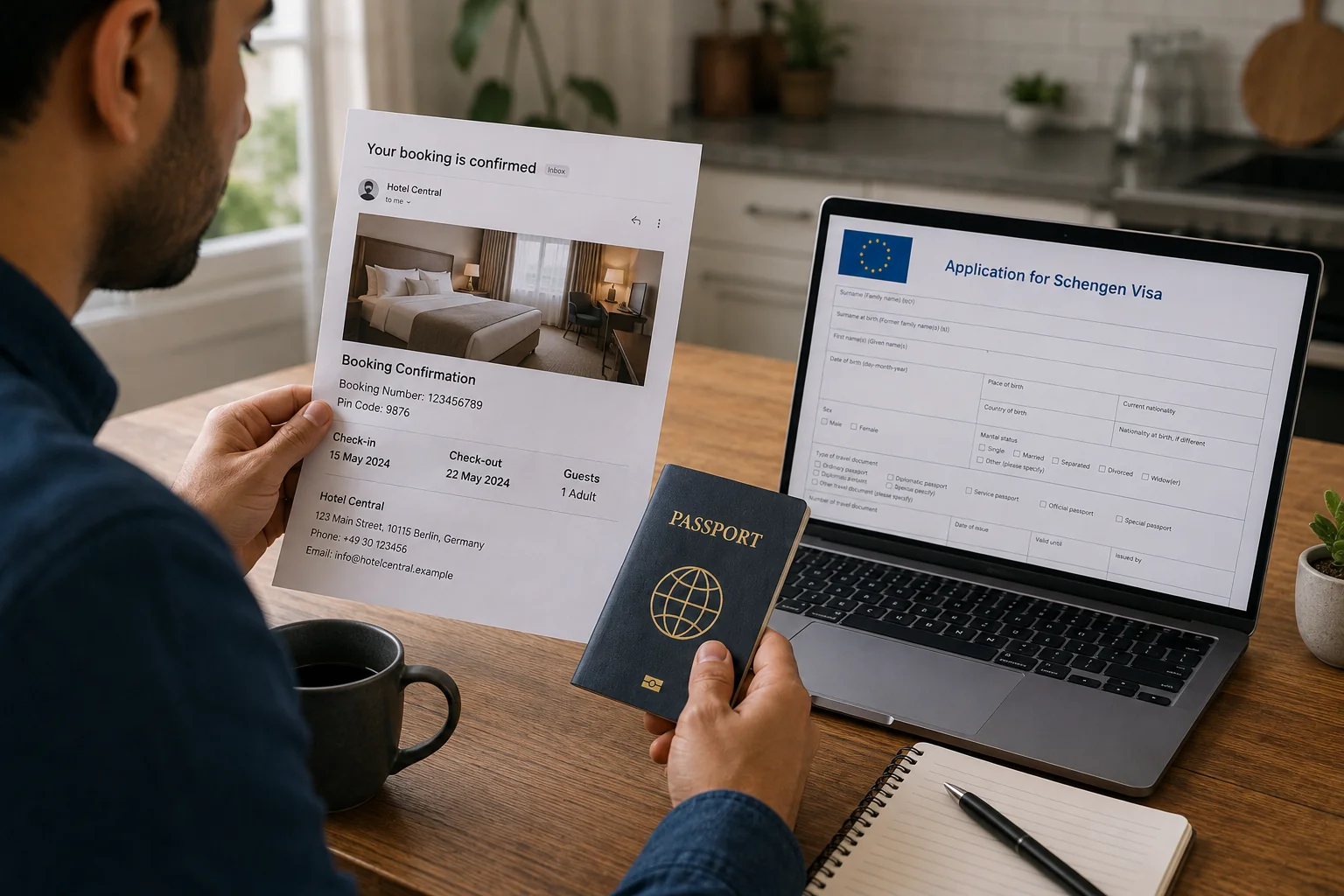
If you want to build out your full application without second-guessing the formatting, start with our visa document tools, which cover everything from itineraries to accommodation proof in the format consulates expect to see. And whatever you submit, always double-check the current requirements on your consulate’s official page before you send off your application — rules and fees shift, and the official source is the one that’s always right.
Ready to prepare your visa documents?
Generate itineraries, hotel booking proofs, passport photos and more in minutes - free.