You’ve filled in the application form, gathered your bank statements, and booked travel insurance — and now the consulate wants a day-by-day plan of a trip you haven’t fully worked out yet. It feels backwards. But since the EU rolled out its new digital border system, an exact itinerary for Schengen visa applications has gone from “nice to have” to something consular officers and border guards actually cross-check against what happens when you arrive.
Here’s the thing: the Schengen area isn’t just reading your paperwork once and forgetting about it. It’s now recording your entries and exits electronically, every time, at every border. That changes what “good enough” looks like for your travel plans.
What Changed: EES and the Digital Border in 2026
The Entry/Exit System, or EES, is the EU’s biometric border-tracking system. It replaces manual passport stamping with fingerprint and facial recognition checks that log exactly when non-EU travelers enter and leave the Schengen area. It began its phased rollout on 12 October 2025 and has been fully operational at external border crossing points across all 29 participating countries since 10 April 2026. If you’re reading this and planning a trip for later this year, you should assume every border you cross into or out of the Schengen area is now checking you against this system, not stamping a page and waving you through.
What this means practically: the days you actually spend in each country are now recorded automatically, and they’re compared against what you told the consulate you’d be doing. A cover letter that says “two weeks touring Europe” with no real detail behind it used to slide by more often than it should have. Under EES, a mismatch between your stated plans and your recorded movements is a data point that follows you into your next application.
There’s a second system worth knowing about, even though it isn’t live yet. ETIAS — the European Travel Information and Authorisation System — will require visa-exempt travelers, including most US and UK passport holders, to get a €20 pre-travel authorization before flying to Europe. It is not a visa; it’s closer to the ESTA that the US already requires for visa-exempt visitors. As of mid-2026, eu-LISA’s official materials still reference a late-2026 target, but multiple independent reports now point to a further delay into 2027, following the same technical issues that slowed the EES rollout. Check eu-LISA’s official ETIAS page before you travel, since this timeline has slipped more than once already.
Why You Need an Exact Itinerary for Schengen Visa Applications Now
If you’re applying for a Schengen Type C visa — the standard short-stay visa covering tourism, family visits, and business trips of up to 90 days within any 180-day period — your itinerary is one of the documents consular staff use to assess whether your trip is genuine and whether you’re likely to overstay. That’s always been true. What’s new is that an exact itinerary for Schengen visa applications now has to hold up against a system that actually tracks your movements, not just a form that gets filed away.
Consulates want to see where you’ll be, night by night, which cities you’re visiting, and why. Vague plans — “touring Europe for three weeks” with no cities named — are one of the more common reasons applications get sent back for more information or refused outright. A specific itinerary that names the French consulate’s jurisdiction cities you’ll be in, or shows you spending four nights in Rome and three in Florence with matching hotel bookings, reads as a real trip. It also matters for the 90/180 rule: your itinerary needs to add up correctly across the whole Schengen area, not just within one country, since that’s how your allowed days are counted.
This also applies, in a different way, to travelers who don’t currently need a Type C visa at all. US passport holders don’t need a Schengen visa for short tourist stays right now, and that hasn’t changed. But once ETIAS is live, US travelers will need that authorization, and border guards under EES have more visibility into your travel history than they used to. Having a clear, honest plan for your trip — even without a visa requirement attached to it — makes an EES-era border crossing smoother if you’re asked about your plans.
What a Schengen-Ready Itinerary Actually Needs to Include
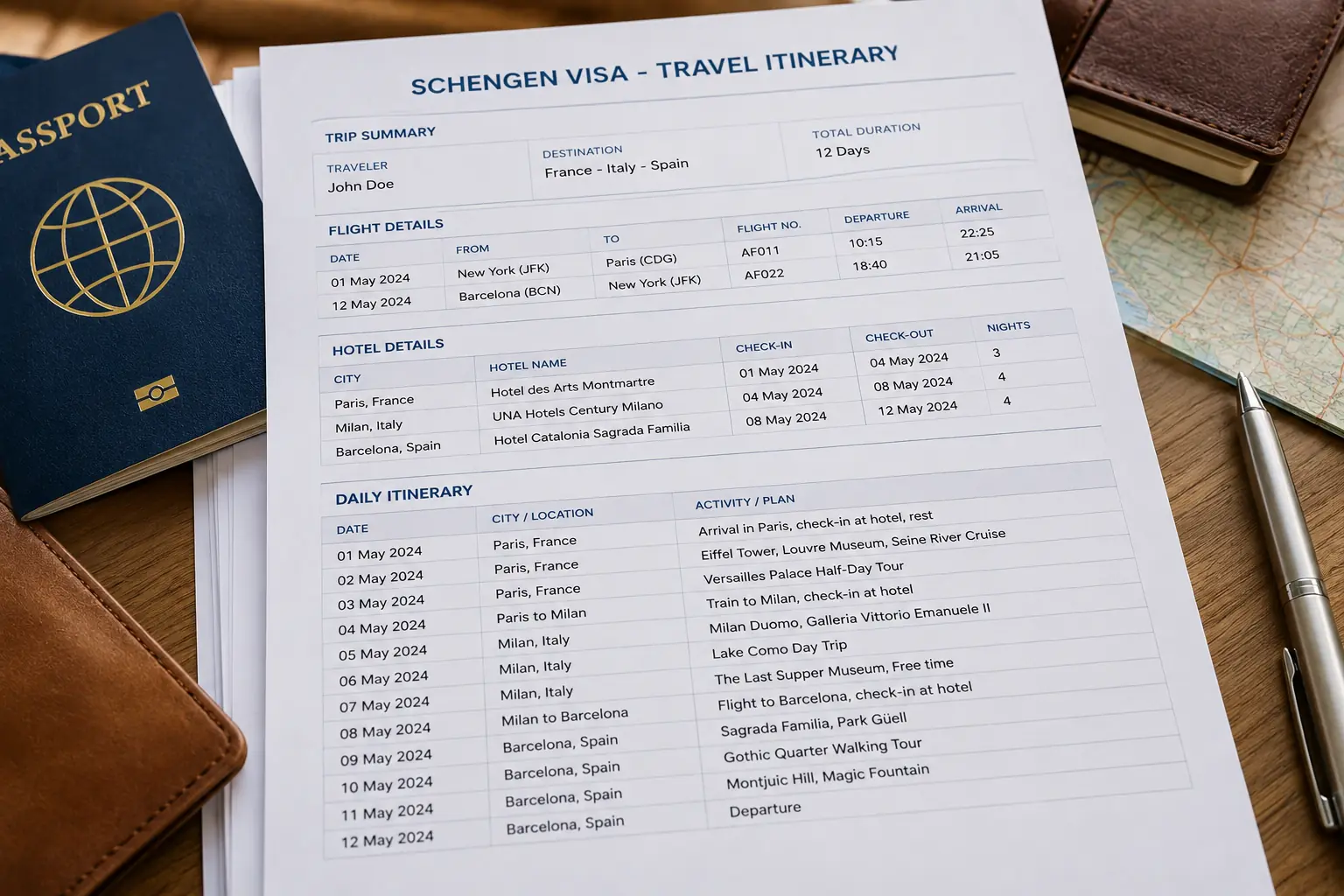
An itinerary that satisfies a consular officer isn’t just a list of city names. It needs to connect to your other documents and hold together as a plan someone could actually follow. Here’s what belongs in it:
| Item | What the consulate wants to see |
|---|---|
| Day-by-day breakdown | Which city or town you’re in each night, matching your accommodation bookings exactly |
| Entry and exit dates | Flight or train details showing when you enter and leave the Schengen area |
| Accommodation for every night | Hotel confirmations, Airbnb bookings, or an invitation letter if staying with a host |
| Purpose of each stop | Tourism, a conference, visiting family — named specifically, not left blank |
| Internal travel | How you’re moving between cities — train tickets, rental car, or internal flights |
| Total days within 180 | A running count showing you’re within the 90-day limit for the relevant period |
Your itinerary should match your proof of accommodation, your flight bookings, and your cover letter down to the dates. If your itinerary says you’re in Amsterdam on the 14th but your hotel booking is dated the 15th, that’s exactly the kind of inconsistency an officer is trained to catch — and now, potentially, the kind of inconsistency EES flags automatically if your actual movements don’t line up either.
Building this by hand in a spreadsheet works, but it’s easy to lose track of which nights are covered and which aren’t. A Schengen visa itinerary generator lays out your day-by-day plan in the format consulates expect, so you’re not reformatting a document at 11pm the night before your appointment.
ETIAS, ESTA, and the UK ETA: Don’t Mix These Up
It’s worth being precise here, because consulates and border agents are precise about it too. A visa and a travel authorization are not the same thing, and mixing them up on your application — or in conversation with a border officer — makes you look less prepared than you are.
Schengen Type C is a visa: an entry requirement decided by the consulate, tied to your passport, that some nationalities need and others don’t. Schengen Type D is a different visa entirely — a national long-stay visa issued by one Schengen country for stays over 90 days, for things like work or study, and it’s not what most tourists need. ETIAS, once it launches, is not a visa at all — it’s a travel authorization for people who are already visa-exempt, similar to how ESTA works for visa-exempt travelers heading to the United States. The UK ETA plays the same role for short visits to the United Kingdom, which sits outside the Schengen area and has its own separate entry rules.
None of this changes because of EES. What EES does is make all of these systems talk to each other more, and make the gap between what you told a consulate and what you actually did at the border much smaller than it used to be. If you’re unsure which category applies to you — visa-required, visa-exempt-but-will-need-ETIAS, or something else — your own country’s nationality is the deciding factor, and it’s worth checking the requirement on an official EU Schengen visa policy page rather than guessing from a forum post.

Building Your Itinerary Without the Stress
None of this means you need to have your trip locked down to the hour before you even start your application. It means the plan you submit should be one you actually intend to follow, with real cities, real dates, and documents that back each other up. Consulates aren’t asking for a fantasy trip — they’re asking for your actual trip, written down clearly enough that a stranger could follow it.
That’s really the whole point of an exact itinerary for Schengen visa applications: it protects you as much as it satisfies the consulate. A vague plan gets flagged for more questions and delays your processing, which currently sits at around 15 days for a standard application and can stretch to 45 days if the consulate needs more information — timelines you’ll want to confirm on your consulate’s own site before you plan your appointment date, since fees and processing windows do shift.
If you’re staring at a blank page trying to turn a rough idea into a document a consulate will accept, start with a travel itinerary generator built for visa applications. It walks you through the day-by-day structure consulates actually expect, so your dates, cities, and accommodation line up the way they need to — and you’re not reinventing the format under deadline pressure. Pair it with your real hotel confirmations and flight bookings, keep every date consistent across your documents, and you’ll walk into your appointment with one less thing to worry about.
Ready to prepare your visa documents?
Generate itineraries, hotel booking proofs, passport photos and more in minutes - free.