You’ve booked nothing yet because you don’t want to lose money if your visa gets refused, but the checklist says you need “proof of accommodation” before you can even submit your application. It’s one of the most common places applicants get stuck — not because the requirement is complicated, but because nobody explains it in plain terms. Here’s what actually satisfies the proof of accommodation for a Schengen visa, and how to get it without paying for a hotel room you might never sleep in.
What “Proof of Accommodation” Actually Means for a Schengen Type C Visa
Every Schengen Type C short-stay visa application — the one that covers tourism, family visits, and business trips up to 90 days within any 180-day period — asks you to show where you’ll sleep for every single night of your trip. Consulates want to see that your stay has a real, verifiable structure, not just that you own a passport and a plane ticket. This is separate from your flight booking and your travel itinerary, though all three need to tell the same consistent story about your dates and locations.
The document itself doesn’t need to be a paid, non-refundable hotel invoice. What consulates are actually checking is whether your accommodation matches your stated trip dates, whether it covers the whole trip with no gaps, and whether it looks like something a genuine traveler would have arranged. A booking confirmation, a signed invitation from a host, or a rental agreement can all work, depending on how you’re actually staying.
Document Checklist: What Your Accommodation Proof Must Include
Whichever consulate you’re applying through — the French consulate in New York, the Spanish consulate in London, or a VFS Global visa application centre in Chicago — reviewers are scanning for the same core details. Missing even one of these is a common reason officers ask applicants to resubmit.
| Detail | Why it matters |
|---|---|
| Your full legal name, matching your passport | Confirms the booking is actually yours, not a generic template |
| Full address of the property | Consulates cross-check this against your itinerary |
| Check-in and check-out dates | Must cover every night with no unexplained gaps |
| Confirmation or booking reference number | Shows the reservation exists in a real system |
| Host or property contact details | Needed if the consulate wants to verify it directly |
If you’re staying in more than one Schengen country during your trip — say, four nights in Amsterdam followed by five in Vienna — you need accommodation proof for each leg, and it should line up exactly with the dates on your travel itinerary for your visa application. Consulates read these documents side by side, and a mismatch of even a day or two between your hotel dates and your itinerary is one of the more avoidable reasons applications get sent back for clarification.
Hotel Bookings, Airbnb, or Staying With Friends: Which Route Fits You
Most applicants use one of three routes, and each has its own paperwork.
A hotel, hostel, guesthouse, or Airbnb/Vrbo booking is the most straightforward option. Consulates don’t require a specific star rating or a particular price point — a budget hostel is treated the same as a four-star hotel, as long as the confirmation shows your name, dates, and address. The key move here is booking through a platform or directly with the property using a free-cancellation rate. You reserve the room, get the confirmation PDF for your application, and cancel afterward if your plans change or your visa is refused, all without losing a deposit. Never submit a booking you don’t intend to honor if the visa is approved — the point is flexibility on cancellation, not a document that misrepresents your actual plan.
If a relative or friend is hosting you inside the Schengen Area, the accommodation proof usually takes the form of a formal invitation or hosting letter, sometimes alongside a certificat d’hébergement in France or a similar local form in other countries. This letter should state the host’s full name and address, their relationship to you, your planned dates, and a copy of the host’s ID or residence permit. Because this document needs to look like an official letter rather than a casual note, many applicants use a formatted letterhead for a hosting or cover letter so it reads clearly and professionally when the consulate reviews it.
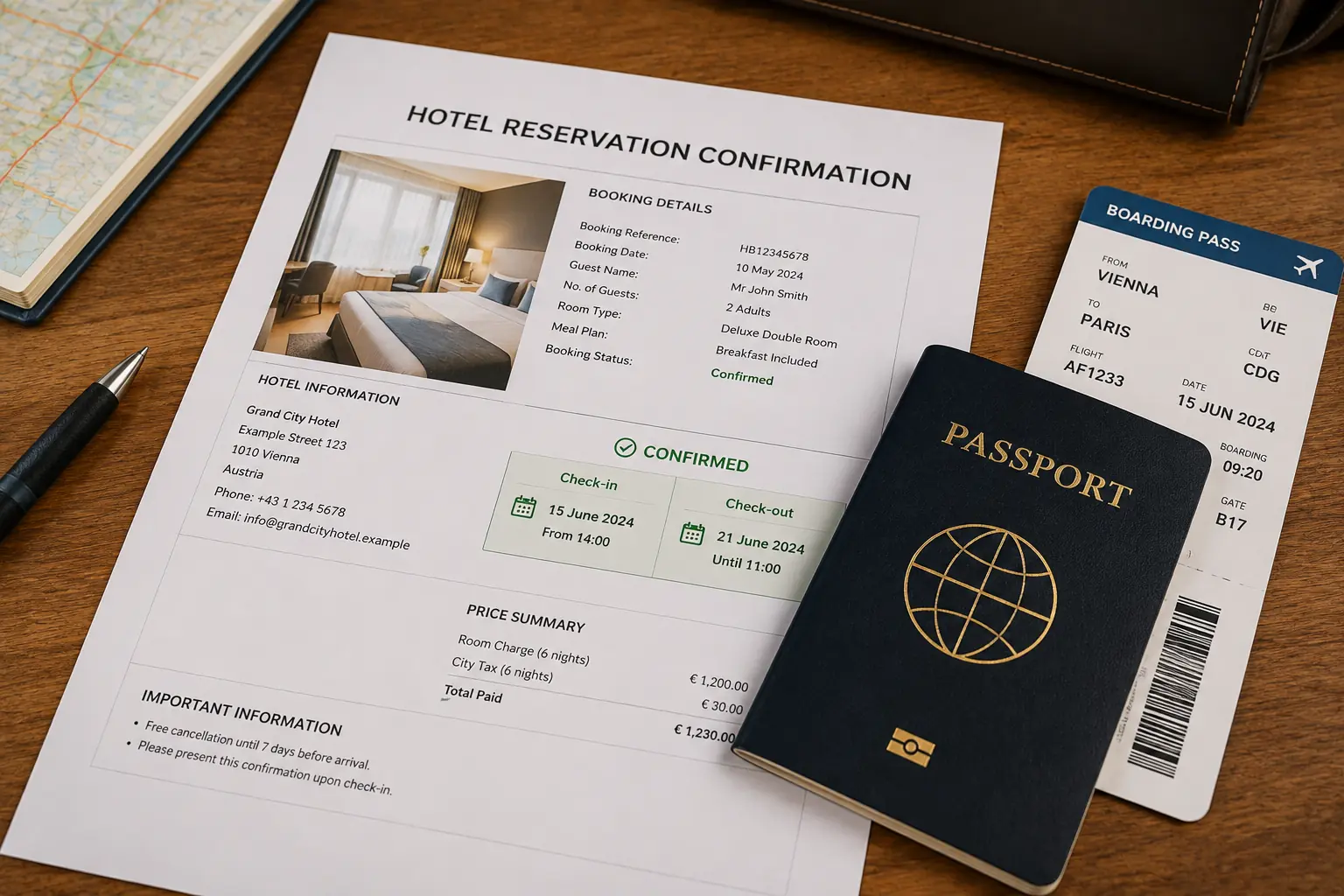
Longer stays or trips through several cities sometimes combine both: a few confirmed hotel nights at the start, then a host letter for the rest. That’s fine, and it’s actually common. What matters is that together, the documents account for every night of the trip with no unexplained days in between.
Fees, Processing Times, and the New EES and ETIAS Rules to Know
The Schengen visa fee is set centrally by the EU rather than by individual member states, so it’s the same whether you apply in New York, London, or Berlin — but it has changed before and can change again, so confirm the current amount on the European Commission’s official visa policy page before you pay. As of this writing, the standard adult fee is €90, with a reduced fee for children aged six to eleven and no fee for children under six; consulates and outsourced visa centres like VFS Global or TLS Contact may add their own service charge on top of that. Standard processing is quoted as up to 15 calendar days from a complete application, though it can extend to 30 or even 60 days during peak summer months or if the consulate requests additional documents — apply as early as your consulate’s booking window allows, and never later than 15 days before you travel.
Two border systems are worth knowing about if you’re heading to Europe from the US or UK. The Entry/Exit System (EES), which replaces manual passport stamping with biometric registration at the external Schengen border, has been fully operational across participating countries since spring 2026 — expect to have your fingerprints and photo taken the first time you cross after your visa is issued, and build in extra time at the border for that. ETIAS, the separate travel authorisation for visa-exempt travellers, is not relevant if you’re applying for a Schengen Type C visa, since ETIAS only applies to travelers who don’t need a visa at all. Its own rollout has been pushed back — eu-LISA’s official page has listed a Q4 2026 launch, but more recent industry and press reporting points to a further delay into 2027, so check eu-LISA’s official ETIAS page for the current status if you’re tracking it for a future visa-free trip.
US passport holders currently don’t need a Schengen visa at all for short tourist stays, so none of the fee or accommodation-proof requirements above apply to them for trips under 90 days — this article is for green card holders, non-US citizens residing in the US, UK nationals on longer or specific-purpose trips, and anyone else who does need a Type C visa. If you’re unsure which category you fall into, your consulate’s own eligibility page is the place to check, not a forum thread.
Get Your Accommodation Proof Ready in Minutes
Pulling together accommodation proof, a matching itinerary, and a host letter under deadline pressure is exactly the kind of paperwork that turns a straightforward trip into a stressful week. You don’t need to book and prepay a hotel just to have something to submit, and you don’t need to format a hosting letter from scratch either.
TravelDocGenerator’s hotel booking proof generator builds a clean, consulate-ready accommodation confirmation from your actual planned stay — the dates, the property, your name — so it matches the rest of your application without the guesswork. Pair it with your itinerary and, if you’re staying with a host, your invitation letter, and you’ll have every date accounted for before you ever set foot in the consulate. If you’re prepping the rest of your Schengen application at the same time, the full set of visa document tools covers the other pieces — bank statement formatting, cover letters, and passport photos — from the same starting point. Once you’ve got real, verifiable documents that reflect the trip you’re actually planning, this part of the application stops being the thing you’re dreading.
Ready to prepare your visa documents?
Generate itineraries, hotel booking proofs, passport photos and more in minutes - free.